THE EXCAVATOR · CURIOSITY
You feel seen when someone wants to go deeper.
Before you read: Take this with a grain of salt and a healthy dose of your own intuition. 18 questions can hand you a useful map — they can't know everything about you. If something here resonates, lean into it. If something doesn't quite fit, trust that over anything written here. You know yourself better than any framework does. This is just here to give language to what you may have already been sensing.
at a glance…
What lands
Real curiosity. The second question, the third question and the willingness to understand beyond the headline.
What often misses
Surface acknowledgment followed by a quick conclusion or solution.
What your care may accidentally communicate
Your questions can feel like interrogation when someone needs acknowledgment or quiet first.
A sentence to ask for it
“Can you ask me a few questions before we try to solve it?”
Who You Are
What tells you someone cares isn't that they listened. It's that they wanted to understand more than the headline.
You feel seen through real questions. Not the polite ones, the ones that show the other person was actually tracking what you said and wants to go further into it. "What did that feel like?" "What happened after?" These aren't interruptions to you. They're the whole point of the conversation.
When someone leans in and asks more, something in you opens. You feel known, not just heard. Most people ask surface questions. The Excavator can feel profoundly alone in conversations that never get below the waterline.
The irony is that you're usually the best questioner in any room, because you know exactly what it feels like to be asked into. You do for others what you most need for yourself.
How It Developed
Excavators often grew up in environments where being deeply understood wasn't the default. Maybe emotions were present but not explored. You were a kid with a lot going on internally, and the people around you were operating at the level of "fine, thanks."
Some Excavators developed this language through a single transformative experience, a teacher, a therapist, a friend who stayed curious past the point where everyone else would have moved on. Others developed it as a form of protection: in environments where full self-disclosure wasn't safe, being asked into was a way of having permission to share without taking the full risk of volunteering.
The Excavator's need to be asked real questions has roots in attachment and attunement. When a caregiver is genuinely curious about a child's inner world, that child learns that their complexity is welcome. When that attunement is absent, the hunger for it sharpens rather than disappears.
The origin sections are possibilities, not diagnoses. A similar need can develop through temperament, childhood, culture, later relationships or repeated experiences across a lifetime.
In Your Life
Romantic Partnerships.
You need a partner who is genuinely curious about you, not just loving toward you. Partners who are warm and supportive but not particularly curious can leave you feeling surprisingly alone.
Friendships.
Your closest friendships have a quality of mutual depth. You tend to be a magnet for people who need to think out loud, because your questions make space for that.
Work & Leadership.
You work best in environments where thinking is taken seriously, where it's okay to say "I'm not sure, let me think about that" and actually think about it. As a leader, you ask the questions others aren't asking.
With Yourself.
Self-inquiry is genuinely your home territory. The trap: using inquiry as a way of perpetually avoiding the thing you've already found. Sometimes the most useful thing is to stop asking and sit with what you've already discovered.
The Gift & The Wound
The Gift.
You ask the question nobody else asked. The one that gets to the real thing. People leave exchanges with you having thought about themselves differently, sometimes for weeks.
The Wound.
Being understood at the surface level by people who think they've gone deep. Someone asks a good question, you start to open, they respond to the first thing you said without tracking the rest, and something in you closes. The accumulation is a specific loneliness: feeling like you've never quite been known.
The Shadow Work… The Healthy Excavator & The Wounded Excavator
Healthy Excavator: your questions come from genuine curiosity, you want to understand, not to direct · you can sit with ambiguity without needing to resolve it · you ask and then actually listen to the full answer · you can be present for someone's experience without turning it into an inquiry · depth is a gift you give, not a standard others must meet · you can act on what you know without needing to go one more layer deeper.
Wounded Excavator: your questions are leading, you're looking for a specific answer · you use depth as a way of feeling in control of a conversation · you hear the first part of an answer and start forming the next question · you become impatient with people who don't match your depth · you use inquiry as avoidance, always one more question before you have to act · you judge relationships by how deep they go rather than whether they nourish you.
The distinction that matters: healthy excavation is in service of understanding. Wounded excavation is in service of control, avoidance, or feeling superior to people who don't go as deep.
what becomes possible when this lands…
Being seen is not the finish line. It is what helps something inside you settle enough to tell the truth, receive care, ask sooner and choose from clarity instead of protection.
When real curiosity lands, the part of you that has felt known only at the surface can finally open. Depth becomes insight… and insight can become action.
Don't confuse this with the Witness.
Do not confuse curiosity with the Witness's need for acknowledgment. The Excavator feels seen through exploration. The Witness needs their present reality named first.
Capacity… When You're On Fire
Everything above describes this language… how you most often register being seen. It does not describe how much you have left to give right now. That's a separate thing, and it changes week to week. When you're resourced, your language shows its gift. When you're on fire, it shows a specific shadow. Neither is a character flaw. Both are just true at different times.
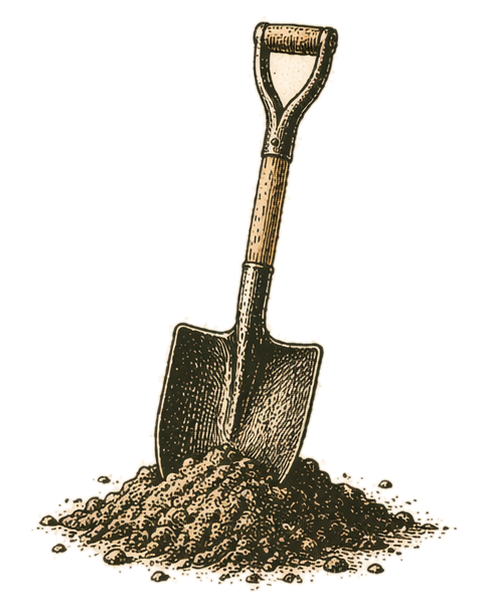
On fire, an Excavator turns the shovel inward. Curiosity becomes rumination, digging without a floor. If your most thoughtful person has gone quiet and spiraling, that's not laziness. That's an Excavator burning.
If you're trying to understand whether someone won't show up or can't right now, look for patterns rather than one moment. Capacity problems often fluctuate and may come with real concern about the gap. Willingness problems tend to stay flat even when the need is clear. One may call for patience and a plan. The other calls for honesty, boundaries and sometimes an exit. And if the burning one is you… compassion for your own fire does not mean staying cold to yourself.
One question worth sitting with: is the next question I'm asking genuinely useful, or am I using it to avoid acting on what I already know?
The Nervous System Layer
When someone asks you a real question and waits for a real answer, something in your nervous system shifts to open. When conversations stay surface-level, something in you stays braced. That performance of accessibility is genuinely draining. It costs more than it looks like it costs.
The Gap Most People Miss… How You Give vs. How You Need to Receive
You give through questions, real ones, the kind that require the other person to actually think.
You need to be asked into. Real questions about the specific texture of your experience, someone who doesn't accept the first answer as the whole answer.
The aha moment: "I've spent years asking people the questions that open them up. I don't think anyone has ever quite asked me the same way back."
Relationship Dynamics & Making It Real
The question that changes things.
You've mentioned something in passing. Three days later a friend texts: "Hey, that thing you said the other day, what was actually going on with that?" You feel something shift.
The meeting where nobody went anywhere.
Everyone is articulate. Nobody is asking the question that would actually get somewhere. You leave feeling like an hour was spent moving around rather than forward.
The relationship audit.
There are two kinds of people in your life: the ones you've actually talked to and the ones you've exchanged information with for years. The line is almost entirely determined by whether they've ever asked you something real.
Practical Toolkit
- Share this framework: "I'm not being intrusive when I ask a lot of questions, I'm trying to actually know you. Here's what it feels like when someone does that for me."
- Ask directly for depth: "Can I tell you something real and have you ask me something about it after?"
- When you're tempted to go deeper instead of acting, check whether the next question is genuinely useful or whether you already have enough to move.
- Not every conversation needs to go somewhere. Save the real questions for relationships that can hold them.
One question worth sitting with: "When was the last time someone asked me a question I didn't have a ready answer for, and I actually tried to find the real one?"
Build a life that fits this part of you.
alignment…
A Validation Language does not dictate your career, relationship or future. But it can reveal which environments repeatedly nourish you… and which ones require you to disappear, overperform or translate yourself every day.
You tend to thrive in
Reflective environments where depth, thoughtfulness and real questions are valued.
Watch for
Surface conversation, rushed conclusions and cultures that reward certainty over curiosity.
The decision you may regret
Going one more layer deeper when the real next step is action.
Your growth edge
Learn when curiosity is opening the door… and when it is keeping you from walking through it.
Not sure if this is you?
Take the quiz to find your primary and secondary validation language, your giving style, and your most common mismatch pattern. [Take the Quiz → /quiz]
The Bigger Picture
People may call you intense. Often what you're really doing is taking them seriously enough to want to know them, and not stopping at the first answer they hand you.
You've spent years asking the questions that open people up. You deserve to be asked into too.
Compatibility Guide… With Other Validation Languages
Excavator + Mirror. Good pairing, Mirrors connect through shared experience, close to the depth you're seeking. Give them the reciprocity they need and they'll go as deep as you want.
Excavator + Witness. Strong pairing. Your questions help Witnesses articulate their experience. Watch for asking before they've felt acknowledged: a brief "that makes complete sense" first covers a lot of ground.
Excavator + Anchor. The pairing worth understanding most. The Anchor's silence can feel like the conversation isn't going anywhere to you. Ask open questions, then actually wait through the pause.
Excavator + Excavator. Potentially the deepest conversations you'll ever have, or two people competing to ask better questions. Notice which one you're in.
Excavator + Keeper. The Keeper remembers what you've shared in detail, which tells you it mattered. Complementary over time.
Excavator + Companion. The Companion may resist being asked into, preferring solidarity over examination. Respect that. Not everyone wants to be excavated, even when they trust you.
Explore the Other Types
a note from paul
I didn't arrive at this from a clean distance. I kept running into versions of these patterns in my own life, then in the relationships and teams I was leading. Eventually the pattern had enough shape that I could name it.
Some of what you just read may feel dead-on. Some may not. Keep what helps. Question what doesn't. This is here to give you language for something you already know… not the final word on who you are.
The longer story of where this framework came from lives on my Story page. [Read the story → /story]
Validation Languages is an original framework by Paul Puzanoski. Living document, work in progress. Not a clinical assessment.
Explore the other five: The Mirror · The Witness · The Anchor · The Keeper · The Companion
the map is the beginning…
Knowing the language is the first map. The deeper work is learning how to ask for it, translate with people who speak differently, recognize capacity and build relationships and environments where more of you can remain visible.